
Addiction Treatment Center Marketing: Your Traffic Has Families in It. Do You Know Who?
Addiction Treatment, Lead Generation
Addiction Treatment Center Marketing: Your Traffic Has Families in It. Do You Know Who?
You already paid for the leads. Every visitor on your site represents a family or individual looking for answers in a difficult moment. For many, this is the first time they have searched for treatment, and the stakes feel overwhelming. Your marketing is not just filling a census target; it is often the first step toward safety and care.
Addiction treatment center lead generation is the process of connecting families and individuals in crisis with treatment facilities that can help them. The urgency in this vertical is not a marketing concept; it is a clinical reality. A family member researching inpatient detox options at 2 AM is in acute distress. They need clear information and a compassionate response, fast.
Every hour between when they find your facility online and when they speak to an admissions counselor is an hour where they could choose another facility, lose their resolve, or face a medical emergency. Speed of response in addiction treatment is not only a business metric; it is a care metric. Your website and outreach process either support that reality or work against it.
Most Families Visit Multiple Treatment Websites Before Reaching Out
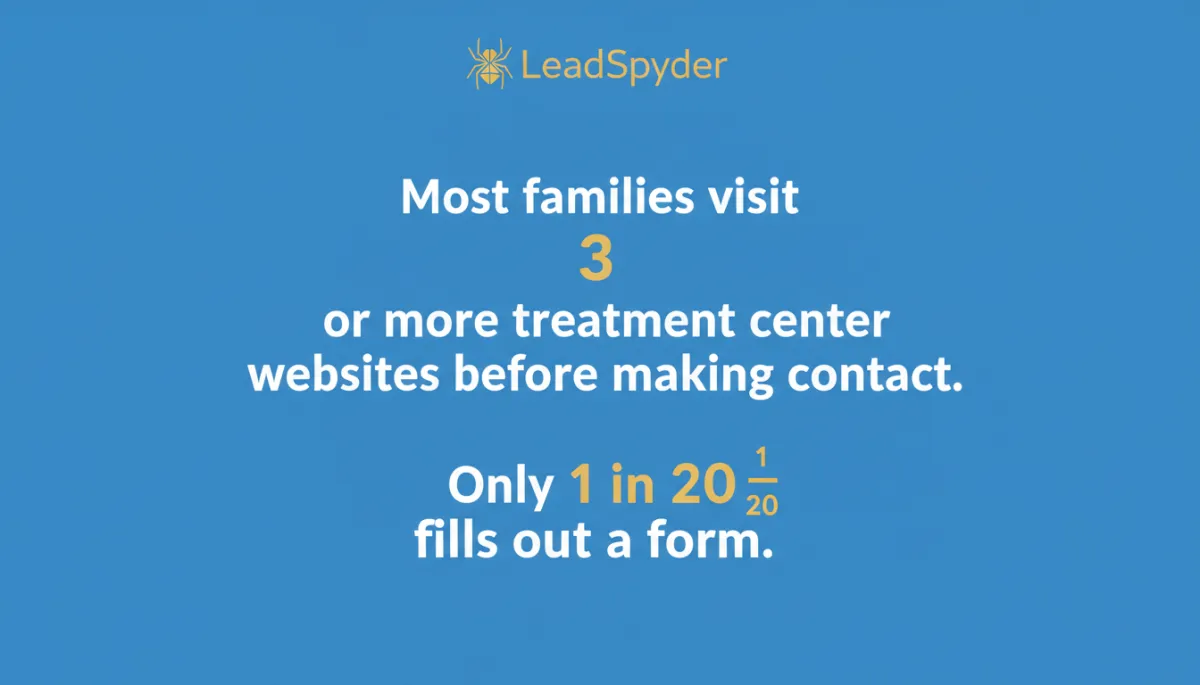
Families rarely contact the first treatment center they find. They open several tabs, scan multiple sites, and compare options quickly. It is common for families to visit three or more provider websites before making a call or filling out a form. They are trying to make a careful decision under real emotional pressure.
On most treatment center sites, only a small fraction of visitors ever identify themselves. Typical conversion rates for form fills or phone calls often sit in the 2% to 5% range, depending on traffic quality and user experience. That means 95% or more of the families you already paid to attract leave without a trace.
What Addiction Treatment Marketing Costs — and Where the Waste Accumulates
Addiction treatment marketing is expensive, and the spend adds up fast. While exact numbers vary by market and channel, conservative industry benchmarks show how quickly costs compound. Think of the following as illustrative ranges, not promises or guarantees.
- Broker leads for addiction treatment can cost several hundred dollars per shared contact.
- Competitive addiction treatment keywords on Google Ads often generate form fills at high cost-per-lead levels.
- Admissions conversion from cold, shared broker leads can be in the single digits, leaving many families unserved and budgets strained.
- Each anonymous visitor on your site represents paid traffic—whether from ads, SEO, referrals, or community outreach—that you cannot follow up with today.
When only a small portion of visitors convert, a significant share of your marketing budget is effectively invisible. Visitor identification changes that equation by turning a portion of those anonymous visits into real, reachable people. Instead of buying more traffic, you get more value from the traffic you already have.
Why Families in Crisis Research Differently Than Typical Consumers
Families searching for addiction treatment are not behaving like typical shoppers. They are evaluating trust, safety, clinical approach, location, insurance acceptance, and outcomes. The research is intense, compressed, and emotionally charged. They are often balancing fear, hope, and urgency at the same time.
On your site, that intensity shows up as deep engagement. These visitors read your detox and clinical program pages, check insurance verification, review alumni testimonials, and study your admissions process. They may do all of this within a single visit, often late at night or between work and family obligations. This is not casual browsing; it is an urgent search for the right next step.
“When a family spends ten minutes reading your detox protocol and insurance page, they are telling you they are close to reaching out. The question is whether you will see that signal in time.”
LeadSpyder translates this behavior into a clear engagement signal. When a visitor views key pages in a focused session, our software can identify a portion of those visitors and surface them to your admissions team as high-intent prospects. This is not about guessing; it is about using real behavior to prioritize outreach.
Visitor Identification: Reaching Families While They Are Still Actively Looking
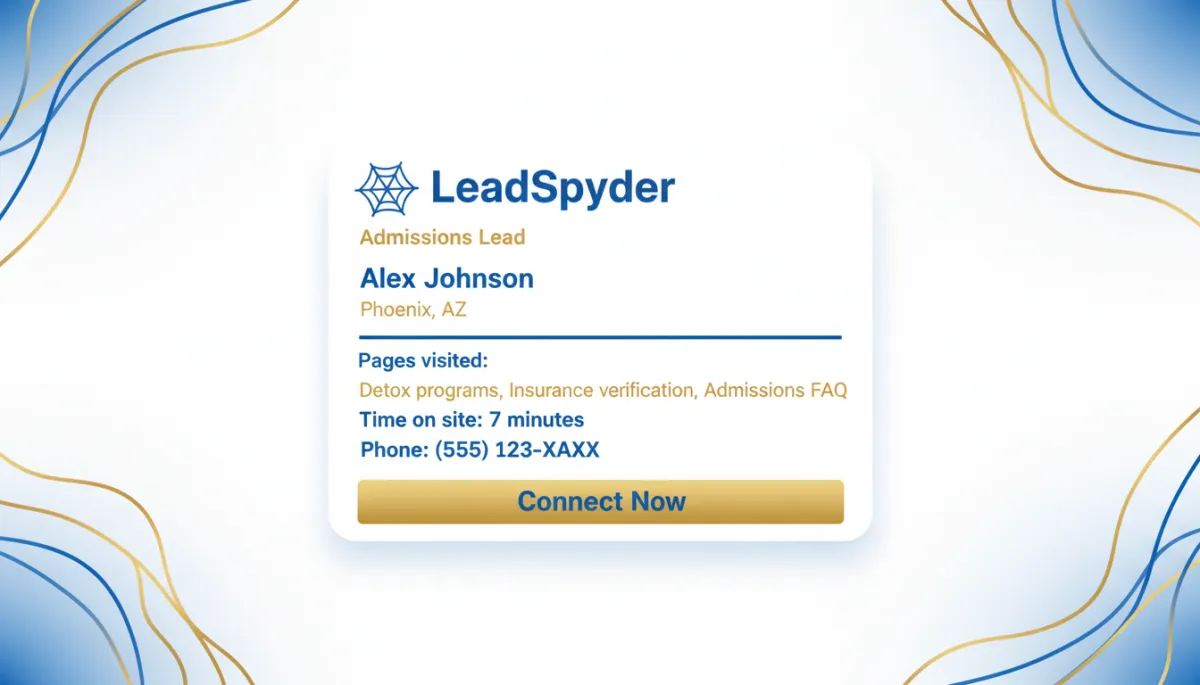
Visitor identification helps your admissions team connect with some of the families who would otherwise leave without contact. By identifying a portion of anonymous visitors and mapping their on-site behavior, LeadSpyder gives you a chance to reach out while they are still in active research mode. This is about timing and presence, not pressure.
- A visitor reads your detox program overview, then checks insurance verification and admissions FAQs in one session.
- LeadSpyder identifies that visitor and creates a lead card with pages viewed and visit timing.
- Your admissions team receives that lead quickly and can offer a respectful, informed outreach.
Speed here is not just conversion optimization. It is the difference between being present when a family is ready to talk and arriving after they have already made a difficult decision elsewhere. The goal is not to “win” a lead, but to be available when help is being actively sought.
An Ethical Framework: Identification as Better Service, Not Better Sales
Some treatment centers hesitate to contact families who have not yet called. That hesitation is understandable and, in many ways, healthy. The ethical framing matters. You are not cold-calling strangers to sell something they do not need. You are responding to a clear signal: they visited your site, engaged deeply, and looked for answers you are qualified to provide.
In this context, outreach is an act of service, not an act of pressure. A thoughtful opening might sound like: “I noticed you were reviewing information about our detox program and admissions process. I wanted to see if you had any questions or needed help understanding your options.” This acknowledges their research, respects their privacy, and offers support without demanding a decision.
Admissions teams should be trained to lead with empathy and information. The first goal is a conversation, not a commitment. When outreach is grounded in respect, families feel seen and supported rather than targeted.
HIPAA, Compliance, and Pre‑Patient Outreach
Addiction treatment facilities are HIPAA-covered entities for their patient populations. Visitor identification, however, operates before a patient relationship exists. The identified visitor has not been admitted, has not disclosed clinical information through a medical intake, and no protected health information has been created in your records at that point.
In this pre-patient context, identified visitors are similar to people who call your main number to ask general questions about your programs before scheduling anything. HIPAA’s marketing provisions address outreach to prospective patients and set boundaries for what is permitted. Always consult your compliance officer or legal counsel to align LeadSpyder’s configuration with your facility’s specific policies and risk tolerance.
For more on why response speed matters so much in this kind of inquiry, see our overview of speed to lead statistics. For a deeper look at how our behavioral health platform is configured for addiction and mental health providers, visit LeadSpyder for Addiction Treatment Centers.
Frequently Asked Questions
What is addiction treatment center lead generation?
Addiction treatment center lead generation is the process of connecting families and individuals seeking treatment with appropriate facilities. Traditional channels include broker leads and paid search campaigns, both of which can be costly and competitive. Visitor identification adds a new layer by turning a portion of your existing site traffic into exclusive, direct contacts your admissions team can support.
Why does speed of response matter so much in addiction treatment marketing?
Families in crisis have narrow windows of readiness to accept help. The emotional state that drives research—urgency, fear, determination—is not permanent. Independent research, including the often-cited MIT Lead Response Management Study, shows that responding to a lead within minutes can be many times more effective than waiting even half an hour. In behavioral health, that timing is amplified by clinical risk and emotional fatigue.
Is visitor identification HIPAA-compliant for addiction treatment centers?
When implemented for pre-patient prospecting, visitor identification can be configured to align with HIPAA’s marketing provisions. Identification occurs before a formal patient relationship exists and before protected health information is created in your systems. That said, every organization has its own policies and interpretations. Your compliance officer should review and approve any deployment to ensure it meets your standards.
How should admissions teams approach outreach to identified visitors?
Lead with empathy, clarity, and respect. Acknowledge that you noticed their interest in specific parts of your site without assuming their full situation. Offer to answer questions about programs, insurance, and the admissions process. The goal of the first contact is a supportive conversation, not an immediate admission. Over time, this approach builds trust and leads to better-aligned admissions decisions.
Your traffic already has names on it. You just can't see them yet. With LeadSpyder, you can identify more of the families you are already investing to reach and connect with them at the moment it matters most.
[Start Free 7-Day Hunt] — https://leadspyder.ai/start
No contract. 30-day money-back. Live in under 10 minutes.