
Third-Party Cookies Are Dead. Here's How Visitor Identification Still Works.
Meta slug: third-party-cookies-visitor-identification
Third-Party Cookies Are Dead. Here's How Visitor Identification Still Works.
You already paid for the leads. The visits, the clicks, the ad impressions — they are not free. So when you hear that third-party cookies are going away, it is natural to worry that you will lose visibility into the traffic you already bought.
This post explains, in plain language, how visitor identification still works without third-party cookies, and why LeadSpyder is built to thrive in this new environment. The short version: LeadSpyder uses first-party signals on your own site plus an identity graph match — no third-party cookies required.
We will walk through what third-party cookies actually did, why browsers killed them, and how first-party, identity graph-based tracking keeps your pipeline moving. Along the way, you will see why the cookieless future is more stable and more accurate for serious lead generation.

What Third-Party Cookies Actually Did — and Why They Went Away
A third-party cookie was a small text file dropped on your browser by someone other than the site you were visiting. An ad network could tag you on Site A, then recognize you again on Site B, C, and D days later. That cross-site tracking powered retargeting, behavioral audiences, and many attribution models.
For years, this was the backbone of digital advertising. But it came with problems. It was noisy, often inaccurate, and raised major privacy concerns. Browsers responded by shutting it down, starting with Safari, then Firefox, and finally Chrome.
Here is the current landscape, using rounded and up-to-date numbers:
- Safari’s Intelligent Tracking Prevention has blocked most third-party cookies since 2017, covering roughly 50%+ of U.S. mobile browser traffic (StatCounter, 2024).
- Firefox’s Enhanced Tracking Protection has blocked third-party cookies by default since 2019, covering about 4% of global desktop traffic (StatCounter).
- Chrome’s third-party cookie deprecation impacts around 65% of global desktop browser traffic (StatCounter).
- Publishers who depended on third-party cookie audiences saw CPM drops of 50–70% in early post-deprecation periods (Google internal study, cited by IAB).
- First-party data strategies outperform third-party cookie targeting by about 89% in conversion rates (Boston Consulting Group).
In other words, the old tracking infrastructure is collapsing, and it will not come back. But that does not mean visitor identification has to disappear with it.
The Big Shift: From Cookie Proxies to Real People
Third-party cookies never actually identified people. They only identified browser instances. If one family shared a laptop, the ad system treated all four people as one “user.” If someone cleared cookies, switched browsers, or used incognito mode, the thread broke.
This meant your retargeting and attribution were always built on a shaky proxy. You were paying to reach “a browser that might be your buyer” instead of “the actual person who visited your site.” The cookieless shift is an opportunity to move from this proxy model to something more precise.
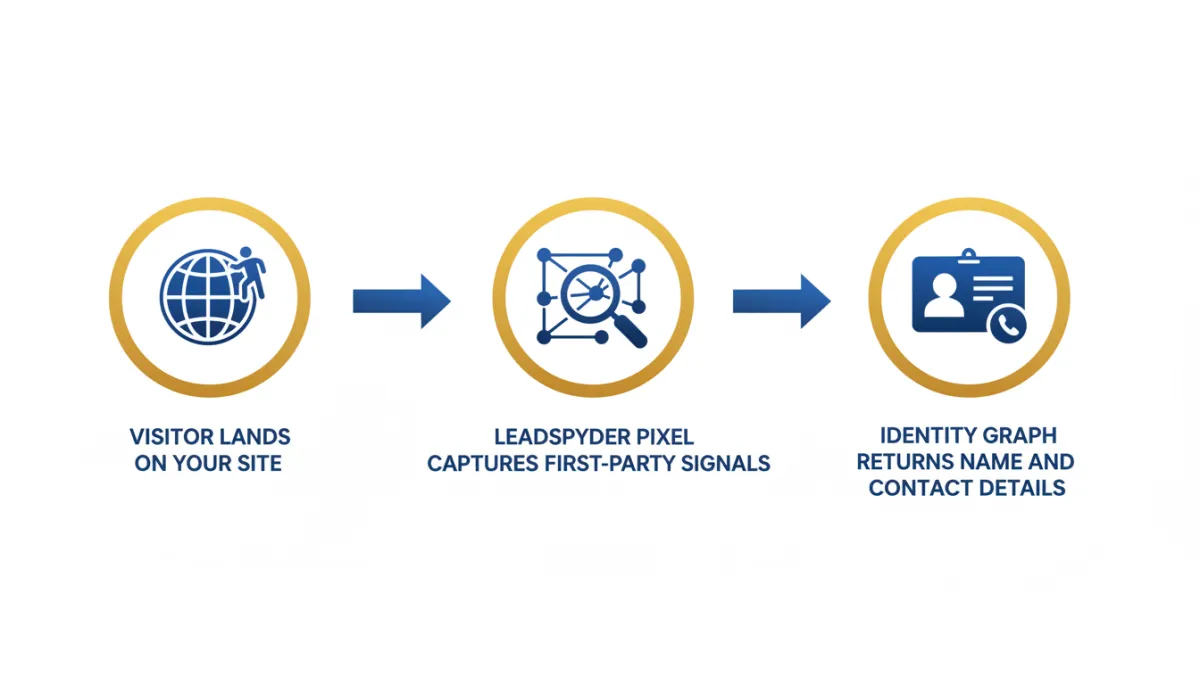
LeadSpyder starts from a different foundation. It focuses on first-party signals on your own site and ties them to a 270 million-profile U.S. identity graph. That combination lets you identify real people behind your traffic — without ever touching third-party cookies.
What LeadSpyder Uses Instead of Third-Party Cookies
LeadSpyder’s WebNet pixel runs entirely on first-party data — information created when someone interacts with your website. These are signals browsers still allow, because they come from the direct relationship between visitor and site owner.
Here are the core first-party signals LeadSpyder can use:
- IP address captured at the server level.
- Device fingerprint built from browser and hardware attributes.
- User agent string (browser type, version, operating system).
- On-site behavior such as pages viewed, time on page, and navigation paths.
- Your own first-party identifiers from your site’s cookies or local storage, when present.
None of this depends on third-party cookies or cross-site tracking. It is all generated by the visitor’s interaction with your site and your server.
LeadSpyder then matches this first-party signal packet against a 270 million U.S. consumer profile identity graph. The graph is built from opt-in and publicly available records, and is maintained independently of browser-level tracking technologies. It does not rely on ad network cookies.
Because the entire process is first-party and graph-based, the cookieless transition has no negative effect on LeadSpyder’s ability to identify visitors. In many cases, it actually increases your advantage over competitors still clinging to cookie-era tools.
Device Fingerprinting: The Core of Cookieless Identification
One of the most powerful first-party signals LeadSpyder uses is device fingerprinting. A device fingerprint is a unique pattern built from dozens of small technical details about a visitor’s browser and hardware.
These details can include browser type and version, language settings, installed fonts and plugins, screen resolution, color depth, time zone, and even how graphics are rendered. On their own, each signal is generic. Combined, they become highly distinctive.
With enough attributes, the system can reliably recognize when two sessions come from the same device, even if cookies are blocked or cleared. This is a major step up from IP-only tracking, which often lumps many devices together behind one address.
By itself, a fingerprint identifies a device, not a person. The real power comes when LeadSpyder combines device fingerprint + IP + behavioral pattern + identity graph match. That full picture lets the system resolve the visitor to a named individual with contact information at match rates cookie-based tools never approached.
Why Cookieless Identification Can Be More Accurate
Cookie-based retargeting often misfired because it treated “this browser” as “this person.” A shared work computer, a family laptop, or a cleared cookie jar all confused the system. You ended up with wasted impressions and broken attribution paths.
Identity graph-based identification flips that around. It starts from individual-level profiles and uses cross-device identifiers to connect the same person across their phone, laptop, and tablet. The result is a more stable and consistent view of who is actually engaging with your brand.
This is one reason Boston Consulting Group found that first-party data strategies beat third-party cookie targeting by about 89% in conversion rates. When you know who is on your site — and you know they chose to visit you — your follow-up is more relevant, better timed, and far more likely to convert.
In a cookieless world, tools that still rely on third-party cookies lose precision and reach. Tools like LeadSpyder, built on first-party signals and identity graphs, keep working — and often perform better because competitors are flying blind.
Future-Proofing Your Lead Generation Against Privacy Changes
Third-party cookie deprecation is not the last privacy change you will see. State laws such as CCPA, VCDPA, and CPA are tightening how data is collected, shared, and sold. Regulators are focusing on opaque, cross-site tracking practices that users never clearly agreed to.
The most resilient businesses will be those whose lead generation strategies rely on defensible, first-party data. That means focusing on visitors who intentionally come to your site and using transparent methods to understand who they are and how to help them.
LeadSpyder’s approach is designed with this future in mind. It uses first-party signals from your own traffic and connects them to a maintained, compliant identity graph. You keep the insight you need to grow, without betting your pipeline on technologies browsers and regulators are actively shutting down.
If you want a deeper technical dive, you can read more about how identity graphs work at what is an identity graph. For a full overview of the platform and the WebNet pixel deployment, see LeadSpyder's visitor identification software.
Frequently Asked Questions
What is cookieless tracking for visitor identification?
Cookieless tracking for visitor identification is the practice of using first-party signals — such as IP address, device fingerprint, browser attributes, and on-site behavior — and matching them against an identity graph to identify who is visiting your website, without third-party cookies. Because it does not rely on cross-site cookies, it keeps working even as Chrome, Safari, and Firefox deprecate third-party tracking.
How does visitor identification work without third-party cookies?
LeadSpyder’s WebNet pixel collects first-party signals from each session on your site. Those signals are combined into a unique session signature and matched against a 270 million-profile U.S. identity graph using probabilistic and deterministic algorithms. When there is a match, you get the visitor’s name and contact details — all without needing any third-party cookie at any step.
Did Chrome’s cookie deprecation hurt visitor identification tools?
It hurt tools that depended on third-party cookies and cross-site tracking. LeadSpyder’s identity graph-based identification was designed to be cookie-independent from day one, so Chrome’s deprecation does not reduce its capabilities. In fact, as cookie-based competitors lose signal, the relative advantage of first-party, graph-based systems like LeadSpyder increases.
Why is first-party data more valuable than third-party cookie audiences?
First-party data comes from people who chose to interact with your site, content, or brand directly. That intent signal is powerful. Studies like Boston Consulting Group’s show that first-party data strategies can outperform third-party cookie targeting by around 89% in conversion rates. The cookieless shift pushes everyone toward these higher-performing, more durable practices.
You already paid for the leads. LeadSpyder helps you finally see who they are.
No contract. 30-day money-back guarantee. Go live in under 10 minutes.