
Financial Advisor Lead Generation: The Prospects Are Already on Your Site
Financial Advisor Lead Generation: The Prospects Are Already on Your Site
You already paid for the leads. The real problem is that most of them leave your site without ever filling out a form, booking a call, or picking up the phone.
Financial advisor lead generation is about finding the people who are actively comparing firms right now, and reaching them before they choose someone else. Those prospects are already on your website, quietly reading your AUM minimums, fee schedule, and retirement planning pages.
Without visitor identification, that research happens in the dark. With it, a portion of those anonymous sessions turns into a clear, contactable pipeline of warm, high-intent prospects.
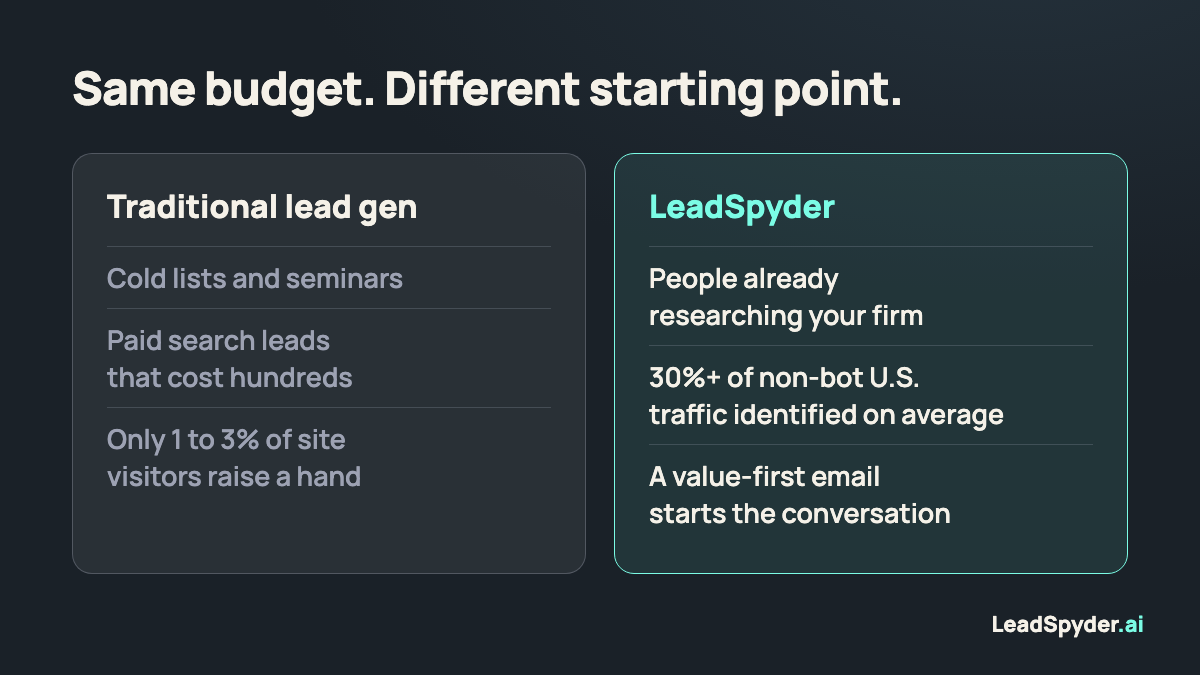
You Already Paid for the Leads (But Only 1 to 3% Ever Raise Their Hand)
Most financial services websites convert only about 1 to 3% of visitors into inquiries or booked calls. That means 97 out of 100 people who land on your site leave without telling you who they are.
Some of those visitors are casual readers. But many are serious prospects: business owners thinking about a liquidity event, pre-retirees comparing income strategies, or high-net-worth families evaluating whether to change advisors.
LeadSpyder helps you see more of those visitors. On average, LeadSpyder identifies 30% or more of non-bot, U.S.-based website traffic (results vary by site), which means you can identify a meaningful share of the people who would otherwise disappear completely.
Instead of paying again and again for cold lists, seminars, and lead vendors, you can start with the traffic you already own and turn it into a steady source of warm conversations.
Why Financial Advisor Lead Generation Is Getting More Competitive
Independent advisors and RIA firm owners are competing harder than ever for the same pool of qualified prospects. Digital research has made it easy for investors to compare multiple firms with just a few clicks.
- There are more than 330,000 registered investment advisors and financial advisors in the U.S., all chasing similar types of clients.
- Cost-per-lead for financial services through paid search often runs into the hundreds of dollars per inquiry.
- Investors who research advisors online typically look at several firms before deciding who to contact.
- Most high-net-worth investors now use digital research as a key step in selecting an advisor.
- Identified visitors from financial advisory sites through tools like LeadSpyder often cost a fraction of traditional paid leads.
When the majority of your ideal clients are checking you out online before they ever call, identifying who is doing that research becomes a real competitive edge. The firm that can see and contact those visitors first has a better shot at winning the relationship.
What High-Intent Financial Advisor Prospect Behavior Looks Like
Not every visitor deserves outreach. Your blog readers, existing clients logging in, and even competitors all generate pageviews. The key is to separate casual browsing from true evaluation behavior.
LeadSpyder’s intent model, SpyderScore, focuses on the patterns that usually show up when someone is seriously considering hiring an advisor. Think about what a real prospect does when they are close to making a decision.
For financial advisors, high-intent behavior often includes:
- Visiting your AUM or minimum investment requirement pages.
- Reviewing retirement planning, tax planning, or estate planning service pages.
- Reading your fee structure or pricing information.
- Spending time on advisor biography or “About the firm” pages.
- Returning to the same key pages across multiple visits.
When a single visitor hits several of these pages in one session, or returns to dig deeper over a few days, SpyderScore flags them as high intent. That is very different from someone who reads one blog post and bounces.
By focusing on this kind of behavior, you can prioritize your outreach for the people who are most likely to be ready for a conversation.
From Anonymous Session to Clear Prospect Card
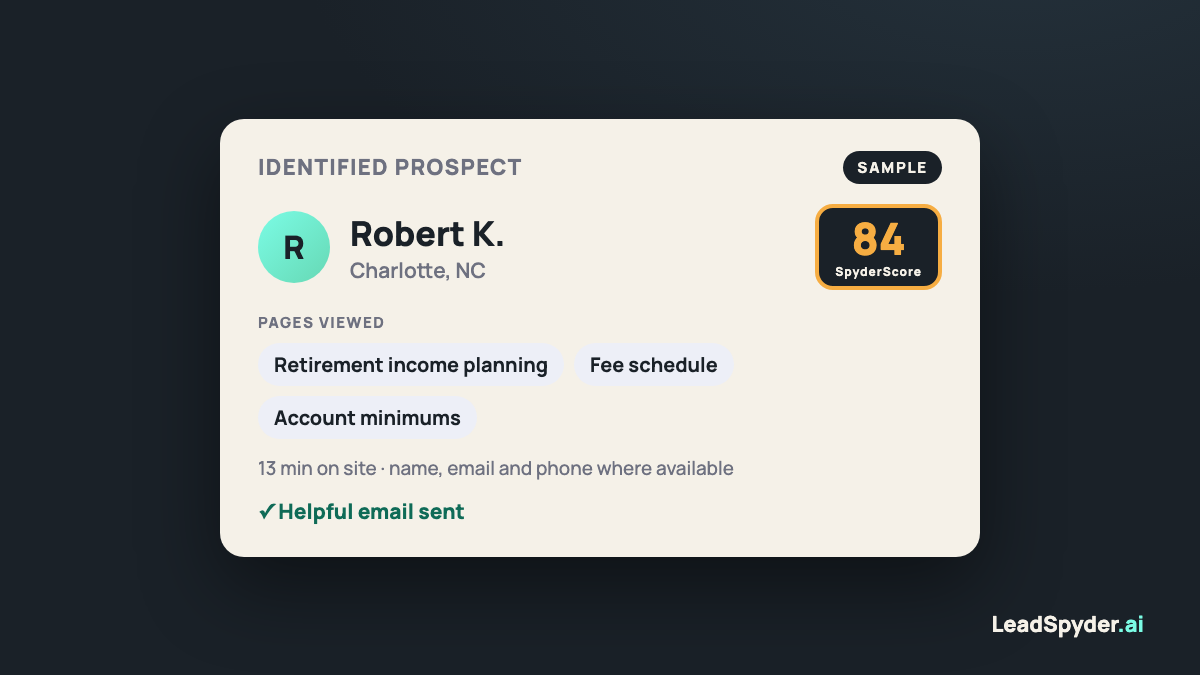
Here is what this looks like in practice. Instead of seeing “1 user from Chicago, 11 minutes on site,” you see a simple prospect card with real details you can act on.
A typical identified visitor record might include:
- Name and city.
- Email address and phone number.
- Pages visited, such as “Retirement planning,” “AUM calculator,” and “About the firm.”
- Time on site and number of visits.
- An intent score that helps you decide whether to reach out today or watch for a second visit.
This turns a vague website session into a clear, prioritized prospect. You know what they were looking at, how long they spent, and whether they came back.
Instead of guessing who might be interested, you can spend your time on the people whose behavior already tells you they are evaluating advisors.
A Compliance-Aware Approach to Visitor Outreach
Financial services is a regulated industry, and that does not change just because the lead source is your website. The good news is that visitor identification itself does not create an advisory relationship or involve client financial data.
At the point of outreach, the individual is still a prospect. Your outreach email is treated like any other business development activity and is subject to the same FINRA and SEC communication rules you already follow.
That means you should avoid promising performance or specific returns in your outreach, just as you would with any other marketing or prospecting effort. The identification data simply tells you who to contact and what they were interested in.
Your compliance officer can review your outreach scripts and email templates the same way they review seminar invites, drip campaigns, or referral follow-ups. The process remains familiar and manageable.
How Identification Changes the Prospecting Conversation
Cold prospecting in financial services is tough. Calling people who have never heard of you requires a long introduction, and you start with a trust deficit before you even explain what you do.
Warm outreach to someone who just spent several minutes on your retirement planning or tax strategy pages is a completely different experience. They already have some context for who you are and what you offer.
A first email might sound like this: “Hi, this is Alex from Meridian Wealth Advisors. People planning for retirement often ask us the same few questions about income and taxes, so we put together a short guide. Happy to send it over or answer any questions you have.”
That feels more like service than interruption. You are showing up at the moment they are thinking about these decisions, with help on the topic they care about. Reference the topic, never the visit. When they reply, your team or your AI Employee takes it from there by phone, chat or text.
Because you know which topics interest them, you can focus your outreach on what matters most to them, whether that is income planning, tax efficiency, or understanding your fee structure.
What This Could Mean in Real Numbers
Let’s walk through a conservative example. Suppose your site gets 1,000 visitors per month. At a typical 1 to 3% conversion rate, that is 10 to 30 people who fill out a form or book a call.
On average, LeadSpyder identifies 30% or more of non-bot, U.S.-based website traffic. Results vary by site. Example: at a 30% identification rate, that gives you about 300 identified prospects. Not all of them will be high intent, but a meaningful slice will show the kind of behavior that suggests they are actively evaluating advisors.
Even if only a small percentage of those identified visitors turn into meetings, you are still generating additional opportunities from traffic you already paid for through SEO, referrals, or paid media.
Instead of needing more traffic to grow, you can get more value from the traffic you already have, without changing your entire marketing strategy.
Frequently Asked Questions
What is financial advisor lead generation?
Financial advisor lead generation is the process of finding and engaging people who are actively evaluating wealth management, retirement planning, or investment advisory services. The goal is to reach them before they choose a competing firm.
LeadSpyder focuses on the visitors already on your site. By identifying a portion of those anonymous sessions and ranking them by intent, you can create a steady stream of warm, exclusive prospects from your existing traffic.
How do I identify high-net-worth prospects on my financial advisor website?
Visitor identification technology matches anonymous website sessions to a large identity graph of U.S. profiles. When there is a match, you receive contact details such as name, email, and phone number, along with the pages they viewed and how long they were on your site.
LeadSpyder’s SpyderScore then ranks each identified visitor by intent based on behavior patterns. For example, a visitor who reads your AUM minimums, fee structure, and advisor bios in one session will typically score much higher than someone who skims a single blog post.
Is visitor identification compliant for financial advisory firms?
Yes, when used for prospecting outreach. The identified person is not yet a client, has not shared account-specific financial information through the platform, and no advisory relationship is created by the identification itself.
Your outreach is still governed by the same FINRA and SEC communication rules that apply to any other prospecting activity. You should avoid promising performance or making misleading statements and have your compliance officer review your standard outreach templates as usual.
Why does speed to contact matter for financial advisor leads?
High-net-worth prospects rarely look at just one firm. They are usually comparing several advisors, reading websites, and asking friends for referrals at the same time.
When you can send a helpful email soon after they visit your site, while your content and brand are still fresh, you have a better chance of starting the relationship before they commit elsewhere. Faster, relevant contact often translates into more meetings and more new clients over time.
Your traffic already has names on it. You just cannot see them yet.
[Start for $1: 7 days, up to 50 identified visitors]
No contracts. Cancel anytime. Live in about 10 minutes on average.