
How to Qualify Leads Before You Pick Up the Phone
Sales, Lead Qualification
How to Qualify Leads Before You Pick Up the Phone
You already paid for the leads. The real question is which ones are worth your time on the phone. This guide shows you how to qualify leads before you call, using intent data and SpyderScore, so you spend your day talking to buyers, not browsers.
Traditional qualification frameworks like BANT (Budget, Authority, Need, Timeline) and CHAMP (Challenges, Authority, Money, Prioritization) happen during the call. You burn 30–60 minutes asking questions just to find out if the prospect is even serious. With intent scoring, you qualify by behavior before you ever dial, using what visitors already did on your site.
Why Traditional Lead Qualification Happens Too Late
If you are still relying on BANT questions to qualify, you are qualifying at the slowest possible moment: live, on the phone. By the time you figure out they are not a fit, you have already spent your most limited resource — your time. Multiply that across a week, and it adds up fast for sales reps and owners who also wear the sales hat.
- A typical B2B qualification call can easily run 30–45 minutes just to decide if there is a real opportunity.
- Many inbound leads never move past that first call, because they were only curious, not ready to buy.
- That means hours each week spent on people who were never going to close in the first place.
Now compare that to a world where you know, before you call, which visitors read your case studies, checked pricing, and came back multiple times. Those people have already qualified themselves with their behavior. Your call is not a fishing expedition; it is a focused conversation with someone who is already leaning in.
Behavioral Pre-Qualification: Let Visitors Qualify Themselves
Behavioral pre-qualification uses what visitors do on your site to decide who gets a call. Instead of asking them about budget and timing, you watch for concrete actions. People who are close to buying behave differently than people who are just browsing or kicking tires.
- Pages visited: Someone who reads your pricing, industry pages, and case studies is in a very different place than someone who only hit your homepage and bounced.
- Time on page: Eleven minutes on your pricing page is not an accident. That is a buying signal. Eleven seconds is not the same thing.
- Return visits: A prospect who comes back three or four times in a week is still evaluating you. They have not moved on to someone else yet.
A visitor who checked your pricing page three times this week, spent more than five minutes on site, and read a case study has already told you a lot. They are signaling need, interest, and some level of urgency without filling out a form or answering a single qualifying question. Your job is to see those signals and act on them quickly.
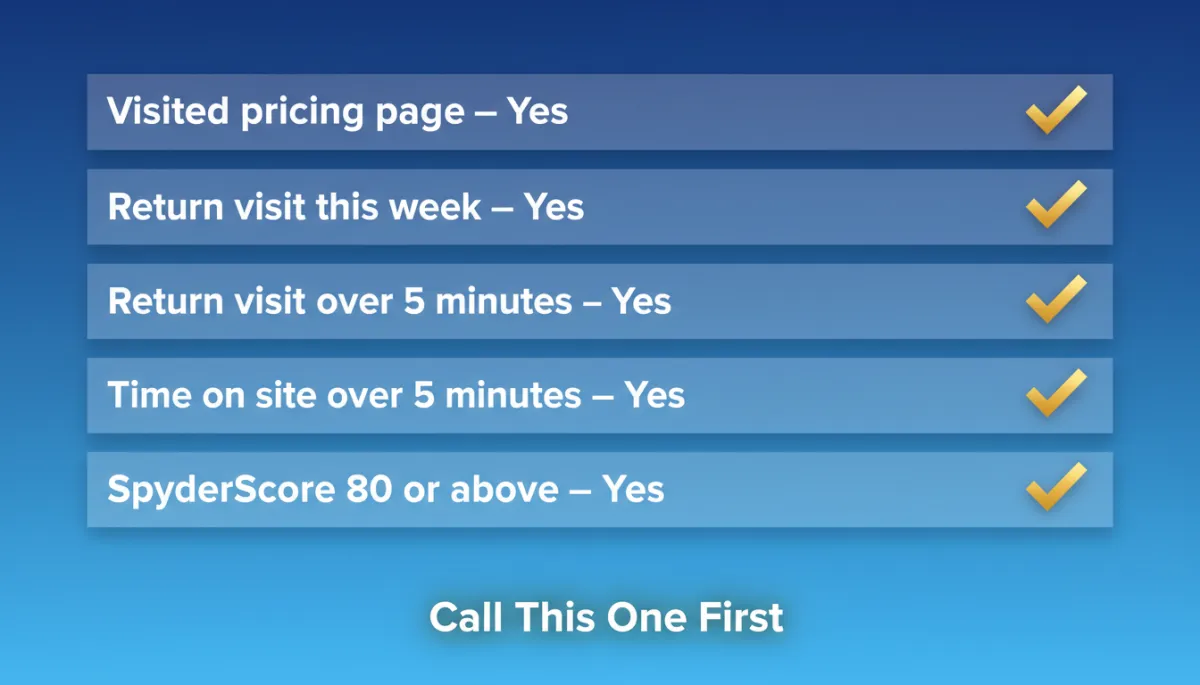
When you combine these behaviors into a simple checklist, it becomes obvious who gets your attention first. You stop guessing and start prioritizing. That is the heart of intent-based qualification.
What the SpyderScore Pre-Call Profile Looks Like
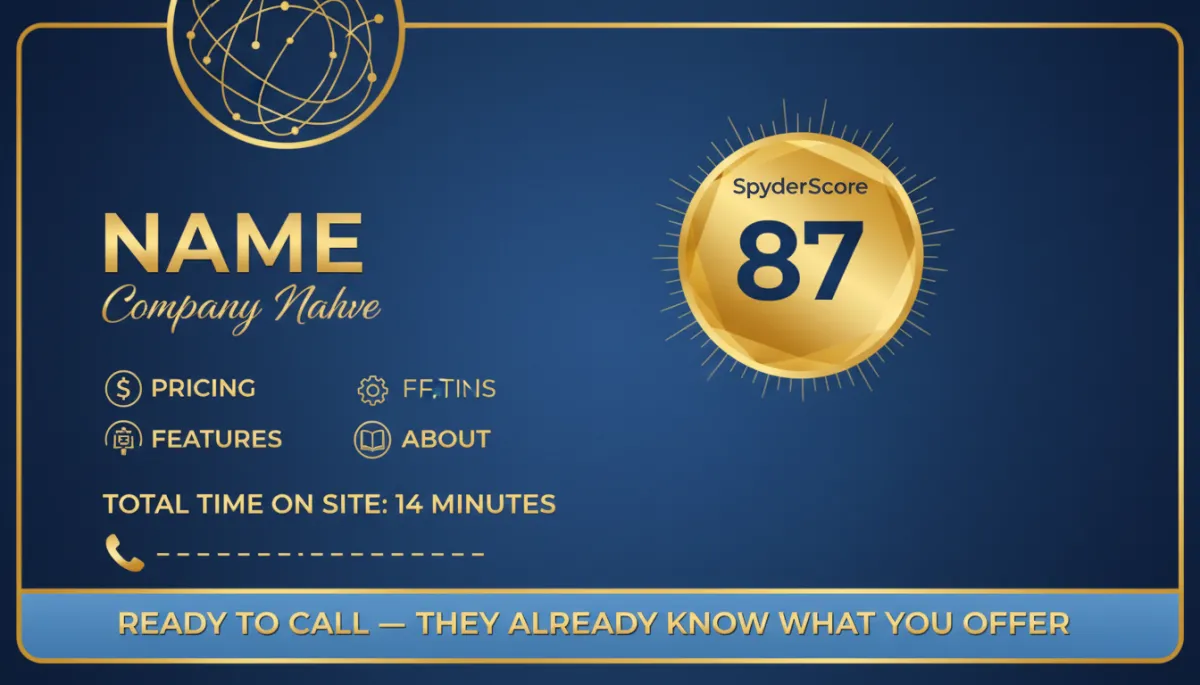
LeadSpyder turns raw visitor behavior into a clear, usable profile your reps can act on in seconds. When SpyderAlert fires on a high-intent visitor, you get a pre-call profile instead of a blank screen and a cold list. You see the story of their visit before you ever say hello.
- Pages visited: Which products, services, or industry pages they viewed, including pricing and case studies.
- Time on site: Total time and time per page, so you can see where they slowed down and paid attention.
- Return visits: How many times they came back and over what time period, which hints at urgency and timeline.
- Contact and company info: Name, email, phone, and in many B2B cases, employer and job title.
On top of that, you see their SpyderScore — a 0–100 score that summarizes all of those behaviors into one simple number. A visitor with a score of 87 who spent fourteen minutes across pricing, features, and about pages is not a cold lead. They already know what you offer and are working through whether you are the right fit.
How SpyderScore Tells You Who to Call (and Who to Nurture)
SpyderScore takes all the behavioral signals — visits, pages, time, returns, pricing views — and rolls them into a single score from 0 to 100. You do not have to manually weigh each signal or build your own model. You just decide how you want to treat different score ranges and stick to it.
- 80–100: Call now. These are your HOT leads. They have shown strong, recent interest and are actively evaluating you. Aim to call within minutes while the visit is still fresh in their mind.
- 40–79: Call soon. These leads are engaged but may not be as urgent. A same-day or next-morning call keeps you timely without chasing every single click.
- Under 40: Nurture, do not dial. These visitors have not shown enough intent yet. Put them into an email or retargeting sequence and let their behavior improve before you invest call time.
This simple rule protects your calendar. Instead of calling every form fill or every click, you focus on the few that matter most. Over time, you end up spending more of your day in real sales conversations and less time trying to drag cold leads across the finish line.
How Intent-Based Pre-Qualification Changes Your First Call
A standard discovery call usually starts the same way: “Tell me about your business. What challenges are you facing? What is your timeline?” You have probably asked those questions hundreds of times. Your prospects have heard them just as often. It works, but it is slow and repetitive for both sides.
An intent-based first call sounds different. Imagine SpyderAlert fires at 2:14 PM on a visitor from a personal injury law firm in Dallas. SpyderScore is 91. They spent six minutes on your PI law page, checked pricing twice, and read a case study. When you call at 2:18 PM, you do not start cold. You can open with exactly what they were just looking at.
“I saw you were looking at our personal injury law platform and specifically the pricing. I wanted to make sure you had accurate numbers and options that work for Dallas-area PI firms. Do you have five minutes to walk through that now?”
That call is about fit, not discovery. They already know what you do from your site. You are there to confirm whether you are the right solution and to handle any remaining questions. The conversation moves faster, feels more relevant, and has a much better chance of ending in a clear next step or even a same-call close.
The Four-Point Pre-Qualification Checklist Before You Call
Before you pick up the phone on any identified visitor, run a quick four-point check using the SpyderAlert profile. This takes about thirty seconds and completely changes how prepared you feel going into the call. You are not just calling “a lead” — you are calling someone whose behavior you already understand.
- 1. Pages they visited: Which product, service, or industry pages did they view? This tells you what use case or problem they care about most right now.
- 2. Their SpyderScore: Is this a HOT lead (80+), a mid-range lead (40–79), or a low-intent visitor (under 40)? That score guides whether you call now, call later, or nurture instead.
- 3. Return visits: Have they been to your site before, and how recently? A repeat visitor deserves an opening that acknowledges they are coming back for more information.
- 4. Company and role: When available, look at employer and job title. This helps you adjust your language and quickly confirm whether you are speaking with a decision-maker or an influencer.
With those four points in mind, your opening line changes from “Can I tell you about us?” to “I noticed you were looking at [specific page] — I can help you with that.” The second version gets you into a real conversation faster and shows the prospect you respect their time as much as your own.
Building BANT Into Your Intent Score Without Asking for It
You do not have to abandon BANT to use intent scoring. In fact, intent data quietly fills in most of BANT before the call. You still confirm details live, but you walk in with a strong head start instead of a blank slate.
- Need: Confirmed by the pages they visited. A visitor deep in your industry or solution pages clearly has a problem they are trying to solve in that area.
- Budget: Suggested by serious engagement with pricing. Someone who spends several minutes on pricing and returns to it is not casually browsing; they are weighing cost against value.
- Timeline: Indicated by return visits over a short period. Multiple visits in a week usually mean they are actively evaluating options now, not someday.
The one piece intent scoring cannot fully answer is Authority. You still need to confirm on the call whether you are talking to someone who can sign or at least strongly influence the decision. The difference is that you are having that authority conversation with someone whose need, budget engagement, and timeline are already pointing in the right direction.
Frequently Asked Questions
How do you qualify leads using intent score?
Intent score qualification uses behavioral data — pages visited, time on site, return frequency, and engagement with pricing and comparison content — to estimate how likely someone is to buy. SpyderScore (0–100) rolls those signals into a single ranking. HOT visitors with high scores are treated as pre-qualified and moved to the front of your call queue.
How does intent-based qualification differ from BANT or CHAMP?
BANT and CHAMP rely on you asking structured questions during the call to gather qualification details. Intent-based qualification reads behavior before the call, confirming need, suggesting budget interest, and hinting at timeline through visit patterns. You still confirm authority and finer points live, but you start the call with a strong picture instead of guessing.
What does a SpyderScore pre-call profile include?
A SpyderScore pre-call profile includes the visitor’s name and contact information, their SpyderScore, every page they visited in current and past sessions, time spent on each page, number of return visits, and visit dates. In B2B cases, you also often see employer and job title. This profile is delivered in real time via SpyderAlert so you can call while interest is still high.
What is a good SpyderScore for prioritizing a sales call?
As a simple rule, treat leads with scores of 80 or above as your top priority and call them as soon as possible. Leads in the 40–79 range are worth a timely follow-up, usually the same day or next morning. Leads under 40 are better suited for automated nurture until their behavior shows stronger intent.
Your traffic already has names on it. You just cannot see them yet. You already paid to get those visitors. Intent-based qualification and SpyderScore help you see who is ready, who needs time, and who is not worth a call yet.
Start your free 7-day hunt — https://leadspyder.ai/start
No contract. 30-day money-back. Live in under 10 minutes.