HVAC Lead Generation: Your Competitors Are Still Paying Angi. You Don't Have To.
HVAC Lead Generation: Your Competitors Are Still Paying Angi. You Don't Have To.
You already paid for the leads.
Every month, you write big checks to Google, Angi, HomeAdvisor, or Thumbtack. You pay for clicks, you pay for “shared” leads, and then you pay again in time and discounts just to win the job.
HVAC lead generation should be simple: keep your techs booked with profitable service calls and replacement jobs. Instead, you are stuck in a race to call the same homeowner faster than three to five other contractors who got the exact same lead.
LeadSpyder takes a different approach. Visitor identification turns the anonymous people already on your website into named homeowners your team can call first — before they ever fill out a form or talk to a competitor.
HVAC Lead Generation: The Real Numbers Behind Shared Leads
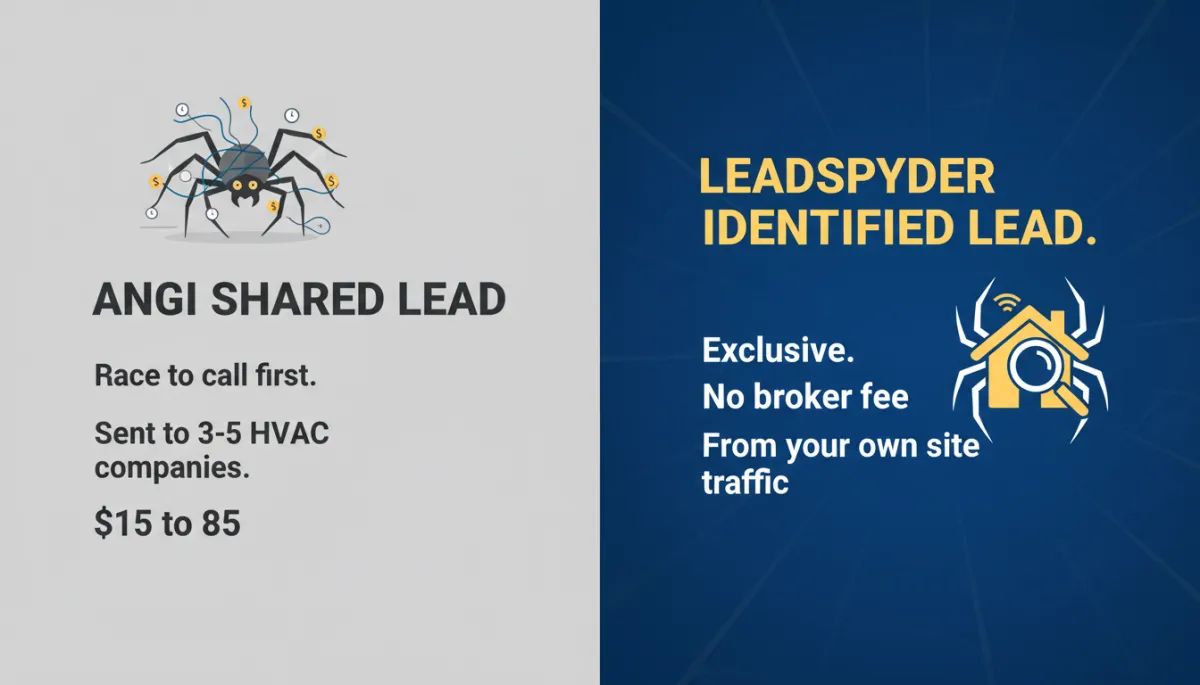
Let’s start with the math you are living with right now. Shared HVAC leads from platforms like Angi and HomeAdvisor typically go out to three to five contractors at the same time.
- Typical HVAC platform lead price: roughly $15 to $100 per shared contact depending on service type and market.
- Average HVAC job value: about $300 for a basic service call and $8,000+ for a full system replacement.
- Shared lead close rates: often in the 4% to 6% range when you are one of several companies calling.
Keep the numbers simple. Take a $60 average cost per shared lead and a 5% close rate. That means you need 20 leads to close one job.
Twenty leads at $60 is $1,200 in lead cost for a single closed job. On a $6,000 replacement, that is 20% of your gross revenue going straight to the lead broker before you pay techs, equipment, and overhead.
On a $300 service call, the math is brutal. You cannot spend $1,200 to chase one $300 job and call that “marketing.” You are effectively working for the platform.
With visitor identification, you do not pay a broker every time the phone rings. You turn your own website traffic into exclusive homeowner contacts at a fraction of that cost per acquisition.
Seasonal Spikes: Your Biggest Opportunity — and Your Biggest Leak
You already know HVAC has two real seasons: the first heat wave of summer and the first real cold snap of winter. Those weeks make or break your year.
During those windows, your website traffic explodes. It is common to see 400% to 700% more visitors than your normal baseline. Homeowners are hot, cold, and frustrated. They search “AC repair near me” or “furnace not working,” click three or four HVAC sites, and call whoever answers first.
Here is the problem. Without visitor identification, only about 2% to 3% of those people ever fill out a form or call you directly. The other 97% to 98% hit your site, read your reviews, glance at pricing, and then disappear to call a competitor.
With the WebNet pixel installed, that same spike behaves very differently. A large portion of those anonymous visitors become named homeowners in your dashboard — with contact details and the exact pages they viewed.
Now, instead of just waiting for the phone to ring, your team can call into that surge of demand while the weather is driving urgency and before the homeowner has spoken to anyone else.
Why Emergency Service Calls Are Built for SpyderAlert
Think about an August afternoon when someone’s AC dies. They are not casually shopping. They are sweating, irritated, and searching on their phone from the couch.
They type “emergency AC repair,” click a few ads or local results, and start tapping through websites. Within minutes they will dial the first company that looks competent and actually picks up.
SpyderAlert is designed for that exact moment. When a HOT visitor lands on your emergency repair or system replacement pages, SpyderAlert fires within seconds.
Your dispatcher or service coordinator sees a live lead card: name, city, phone number, how long they have been on the site, and which pages they visited — for example, “AC replacement,” “financing,” and “reviews.”
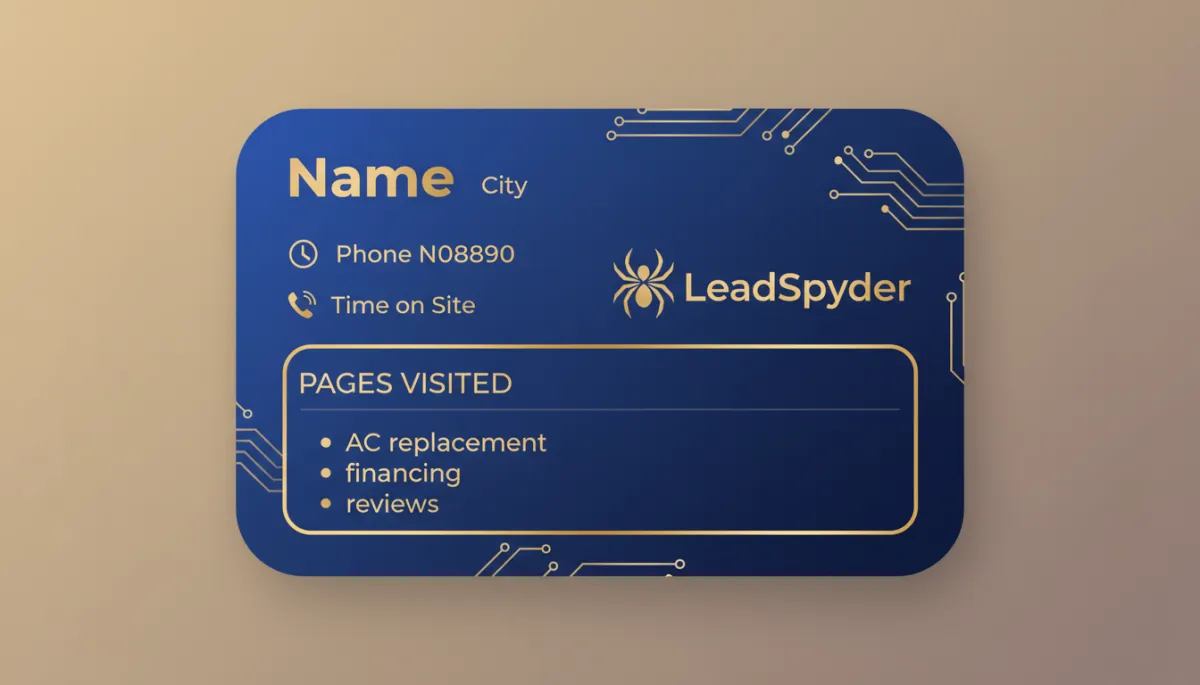
Now your team calls within four minutes, while the homeowner is still on your site and their phone is in their hand. They were going to call someone anyway. You just made sure it is you instead of the guy down the street.
For emergency HVAC, speed-to-contact is not a minor conversion tweak. It is the whole game. First to call wins the job far more often than second or third, no matter how good your pricing is.
What 1,500 Monthly HVAC Visitors Really Produce With Identification
Let’s walk through a simple, realistic scenario. Say your residential HVAC company is getting 1,500 visitors per month from Google Ads and organic search for repair and replacement keywords.
Without identification, your numbers might look like this:
- 1,500 monthly visitors.
- 2% form fill or call conversion = about 30 leads.
- Roughly 8 booked jobs at an average $5,200 ticket = $41,600 in revenue.
That is not bad, but it leaves most of your traffic on the table. Now layer LeadSpyder on top of the exact same 1,500 visitors — no extra ad spend.
At a conservative 20% to 40% match rate, identification turns those 1,500 visitors into 300 to 600 named homeowners per month. These are real people with real contact details who were already on your site.
From that group, SpyderScore flags the highest-intent visitors — the ones on emergency repair or system replacement pages — as HOT. In a typical month, that can easily be a few dozen very serious shoppers.
If your team reaches and closes even a small slice of those HOT visitors, the numbers move fast. Five or six extra jobs per month at a $5,200 average ticket is $26,000 to $31,200 in additional revenue from traffic you were already paying for.
No new ads. No extra Angi or HomeAdvisor budget. Just finally seeing the names on the traffic you already own.
For roofing companies with the same weather-driven spikes, the breakdown is similar. You can see that comparison at roofing lead generation.
If you want a deeper dive on why shared platform leads are so expensive compared to exclusive leads, read exclusive vs shared leads.
Frequently Asked Questions
What is HVAC lead generation, really?
HVAC lead generation is simply finding homeowners who need heating, cooling, or ventilation work and getting them to call you instead of a competitor. Traditionally, that has meant buying shared leads from Angi, HomeAdvisor, or Thumbtack and hoping you can reach the homeowner first.
Visitor identification flips that model. Instead of renting shared leads from a platform, you generate exclusive homeowner contacts from your own website traffic at a much lower effective cost per job.
How much do HVAC leads actually cost on Angi and HomeAdvisor?
Lead prices vary by market and service, but the pattern is the same. You pay per lead, and that lead is usually sold to three to five HVAC companies at the same time.
When your close rate on those shared leads is only a few percent, your true cost per acquisition climbs fast. It is common to end up paying hundreds of dollars in lead fees just to close a single job.
With LeadSpyder, you are not charged per lead. You pay to unlock the names already hitting your own site, then your cost per closed job is driven by your team’s follow-up, not a broker’s price sheet.
Why is speed so important for HVAC emergency leads?
Because in an HVAC emergency, homeowners are not comparing 10 quotes. They are looking for the first competent company that answers and can come out soon.
SpyderAlert delivers identified visitor information within seconds of their visit. When your dispatcher calls while the homeowner is still on your site, your odds of winning that job are dramatically higher than if you call 20 minutes later — or not at all.
How many HVAC homeowner contacts can I expect from identification?
The simple math: at a 20% to 40% match rate, a site with 1,500 monthly visitors will typically generate 300 to 600 identified homeowners per month. During peak summer and winter spikes, that number climbs in direct proportion to your traffic.
SpyderScore then separates emergency-intent and replacement-intent visitors from casual browsers. Your team can focus first on the hottest opportunities instead of treating every visitor the same.
Your traffic already has names on it. You just can't see them yet.
[Start Free 7-Day Hunt] — https://leadspyder.ai/start
No contract. 30-day money-back. Live in under 10 minutes.