
How Marketing Agencies Use Visitor ID to Prove ROI and Win More Clients
How Marketing Agencies Use Visitor ID to Prove ROI and Win More Clients
You already paid for the leads. Visitor identification is how you finally see them.
For marketing agencies, visitor identification turns anonymous website traffic into named companies and decision-makers. Agencies use that data in two powerful ways:
- To spot warm prospects already visiting the agency’s own site and turn them into new clients.
- To offer visitor identification as a monthly retainer add-on that converts client traffic into named leads, typically adding $300 to $800 per month per client in recurring revenue.
Most agencies are already paying to generate traffic, for themselves and for clients. But they only ever see the tiny slice of people who fill out a form. Visitor ID uncovers the rest.
Two Core Agency Use Cases for Visitor Identification
Marketing agency visitor identification is the practice of using website visitor data to serve two distinct business objectives:
- Use Case 1 (Your own pipeline): Generate new business leads for your agency from people already visiting your site.
- Use Case 2 (Client MRR): Sell visitor identification as a billable client service that adds measurable monthly recurring revenue and makes your agency hard to replace.
Most agencies run traffic campaigns for clients every day without capturing a single name from the visitors those campaigns generate. The ones that add identification to their service stack prove ROI in a way that makes them very difficult to fire.
Use Case 1: Capture Warm Agency Leads Hiding in Your Own Traffic
Your agency’s website gets traffic every day. People who:
- Found you on Google while searching for “SEO agency” or “PPC partner.”
- Were referred by a client and wanted to check you out first.
- Saw your work in the wild and looked you up.
Most of them leave without ever filling out a contact form. You never know they were there. Meanwhile, your team is still cold emailing strangers from LinkedIn.
With LeadSpyder installed on your site, that story changes.
Imagine this sequence:
- A business owner hits your “SEO Services” page.
- They read three case studies.
- They spend twelve minutes on your pricing page.
LeadSpyder scores that visitor as high intent and sends a SpyderAlert to your business development person within seconds. Now your first email can sound like this:
“Choosing an SEO partner is a big decision. Here is a short guide to what the first 90 days usually look like, plus a few case studies from businesses like yours. Happy to answer any questions.”
That doesn’t land like a cold pitch. They were already evaluating you. A helpful email on the topic they cared about simply proves you’re responsive. Reference the topic, never the visit. When they reply, your team or your AI Employee takes it from there by phone, chat or text.
Why Most Agencies Miss This (And How to Fix It)
Here’s the uncomfortable truth: most agencies run zero visitor identification on their own site. They do it for clients, if at all, but not for themselves.
Fixing that is simple:
- Add the LeadSpyder tracking pixel to your agency website.
- Set up alerts for key pages like Services, Pricing, and Case Studies.
- Route high-intent visitor alerts to your sales or leadership team.
Within days, you’ll start seeing:
- Named companies and decision-makers who have been quietly researching you.
- Patterns in which services and case studies are driving the most interest.
- Shorter sales cycles because you’re catching prospects while they’re actively shopping.
Before you roll visitor identification out to clients, turn it on for your own agency first. It can pay for itself quickly and gives you real stories to share with clients.
Use Case 2: Turn Visitor Identification into Monthly Recurring Revenue
The second use case is where agencies see the biggest revenue lift.
Your clients are already paying you to drive traffic through SEO, paid media, email, and social. Visitor identification lets you expand each retainer by turning that anonymous traffic into named contacts your client’s sales team can reach with a helpful email.
Typical pricing for agencies is:
- $300 to $800 per month per client for visitor identification as an add-on service.
Across 20 clients, that’s an additional $6,000 to $16,000 in monthly recurring revenue, without hiring more people or increasing ad spend.
The pitch to existing clients is simple and honest:
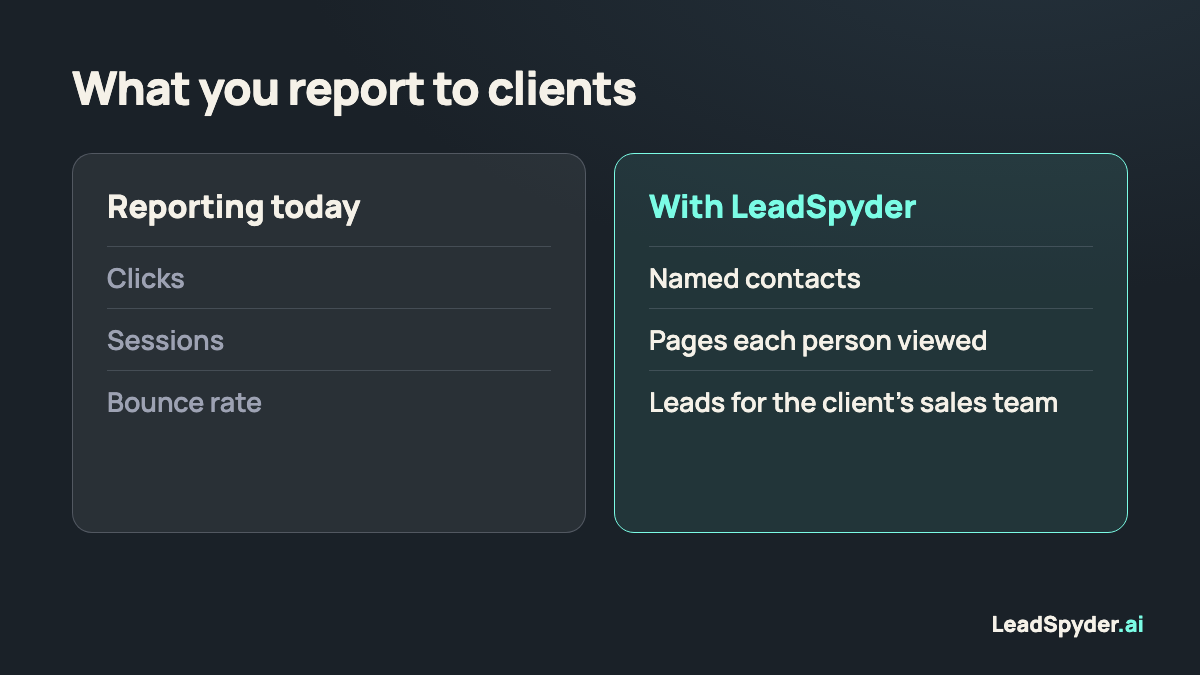
“Right now, about 97% of the traffic we send to your site leaves without filling out a form. With LeadSpyder, I can show you the names and companies of the people who were on your pricing and services pages last week. Your team can follow up with them directly.”
That conversation is an easy one to have. You’re not asking them to buy a theory. You’re offering access to leads they’re already paying to attract.
How Visitor ID Makes Your Agency Hard to Replace
Most agency services are easy to compare:
- SEO deliverables vs. SEO deliverables.
- Click-through rates and CPCs in Google Ads.
- Social posting calendars and engagement rates.
If a client feels their results are flat, they can usually find another agency offering the same services at a lower retainer.
Visitor identification changes that dynamic.
When you’re not just driving traffic, but also turning that traffic into named leads and revenue attribution, switching agencies becomes a much bigger decision.
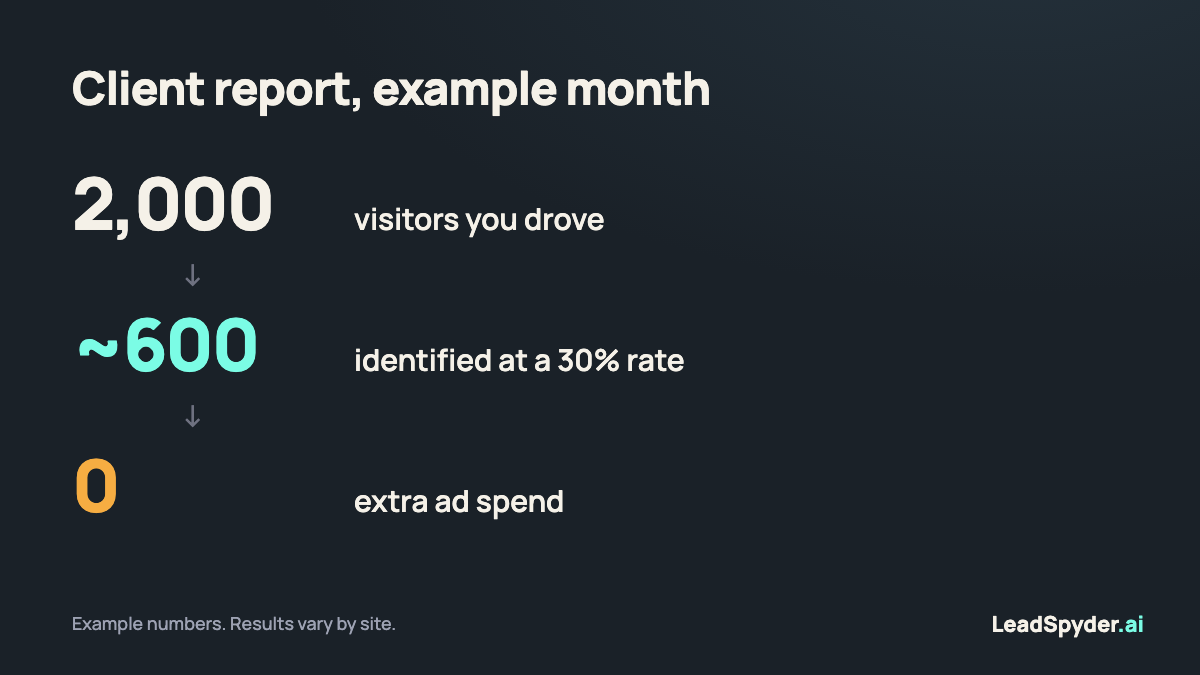
Instead of saying, “We got you 40,000 clicks last quarter,” you can say something like this (example numbers):
“From the 2,000 visitors we drove last month, about 600 were identified at a 30% identification rate. Here are the names, companies, and the pages they visited, so your team can follow up.”
That’s not a generic performance report. That’s a direct line from your work to their revenue. Replacing you would mean giving up that visibility and going back to guessing.
How to Present Visitor Identification Without Overpromising
You don’t need hype to sell this. The data is compelling on its own.
When you introduce visitor identification to a client, lead with what you can show today, not what you think might happen later.
A simple, repeatable way to present it:
- Run LeadSpyder quietly on their site for a short pilot period.
- Pull a sample report of visitors from high-intent pages (pricing, demo, services).
- Highlight:
- How many visitors were identified.
- Which pages they viewed and for how long.
- Which ones look like high-fit accounts.
Then say something like:
“These are 47 identified visitors who were on your pricing and service pages last month and didn’t convert. Your sales team can reach out to them this week. If you want this level of visibility every month, we can add it to your retainer.”
The gap becomes obvious: they’ve been paying for traffic, but only seeing the tiny fraction that fills out a form. Visitor ID shows them the rest.
For a deeper technical breakdown of what the platform delivers to end clients, see LeadSpyder’s visitor identification software overview. To understand how paid traffic identification specifically converts for agency clients, see Google Ads visitor identification.
Frequently Asked Questions
How do marketing agencies use visitor identification?
Marketing agencies use visitor identification in two main ways: first, to generate their own new business leads by identifying companies and decision-makers visiting the agency website; second, to offer identification as a billable service for clients, turning paid and organic traffic into named leads the client’s sales team can work. Both use cases create measurable, attributable revenue outcomes that strengthen agency-client relationships.
How much additional MRR can an agency add by selling visitor identification?
Agencies typically charge $300 to $800 per client per month for visitor identification as a service. With 20 clients on the program, that’s an additional $6,000 to $16,000 in monthly recurring revenue. Larger agencies or those serving high-value verticals often price the service higher and see proportionally bigger gains.
Does visitor identification improve agency client retention?
Yes. When you can show clients named visitors, high-intent leads, and closed revenue tied back to your campaigns, your value becomes much harder to question. Instead of arguing about impressions and clicks, you’re talking about pipeline and revenue. That makes switching agencies both painful and illogical for most clients.
How should agencies present visitor identification to skeptical clients?
Lead with the client’s own data. Run a short pilot, then show them a sample report of identified visitors from their site: who they were, what they looked at, and when they visited. The contrast between their current lead volume and the leads they’ve been missing is visible and quantifiable. For many clients, the first report makes the decision easy.
Your traffic already has names on it. You just can’t see them yet.
Start for $1: 7 days, up to 50 identified visitors
No contracts. Cancel anytime. Live in about 10 minutes on average.