
Retargeting Shows Ads to Anonymous People. Visitor ID Gives You Their Phone Number.
Lead Generation, Retargeting, Visitor Identification
Retargeting Shows Ads to Anonymous People. Visitor ID Gives You Their Phone Number.
If you are running retargeting on Google or Meta, you are already paying to bring people back. But most of those clicks are still anonymous. Visitor identification turns that same traffic into real names, emails, and phone numbers you can call today.
You already paid for the leads. The only question is whether you keep showing them anonymous ads, or you actually talk to them.
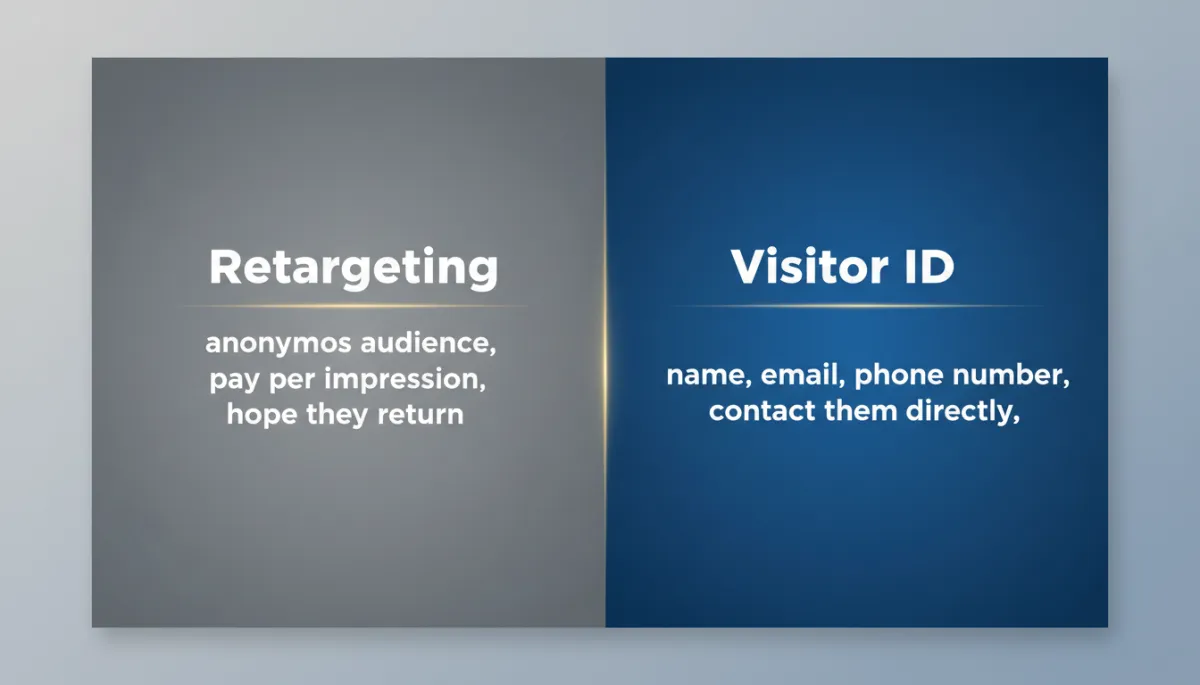
Retargeting vs Visitor Identification: Plain-English Comparison
Retargeting and visitor identification both start from the same place: a visitor hits your site and does not convert. What happens next is where they split. One keeps the visitor anonymous; the other turns them into a contact in your CRM.
- Retargeting: Shows display or social ads to an anonymous audience segment. You pay per impression or click, but the person stays anonymous the whole time.
- Visitor identification: Uses similar pixel data, matched to an identity graph, to return a specific name, email address, and phone number for that visitor.
- With retargeting, you hope they come back. With visitor ID, you can contact them directly without spending another dollar on ads for that person.
The Numbers: What You Actually Pay For
Let’s look at what you are really buying with each approach. Same traffic, different outcomes.
- Retargeting CPL: $5–$15 per click, anonymous — you never know who clicked (Google Display Network, Meta benchmarks).
- Visitor identification CPL: $8–$25 per identified contact, named — name, email, and phone included (LeadSpyder internal).
- Retargeting conversion rate: 1–2% from click to actual contact form or call (industry average).
- Visitor ID close rate: 10–18% close rate on HOT-scored identified contacts (LeadSpyder internal).
On the surface, $5–$15 per retargeting click looks cheaper than $8–$25 per identified contact. But that click does not give you a person you can call. It just buys another anonymous visit with a 1–2% chance they finally convert.
An identified contact, on the other hand, comes with a name, email, and phone number and closes at 10–18% when they are HOT-scored. When you do the math on cost-per-closed customer, the gap is not close.
“Retargeting buys another chance. Visitor ID buys a conversation.”
What Retargeting Actually Does — and Where It Stops
Retargeting is an awareness and memory tool. It keeps your brand in front of people who bounced the first time. They see your banner on ESPN, your carousel on Instagram, your responsive ad on Gmail.
The bet is simple: show them enough ads, and eventually a few will click again and convert. That process takes time, eats budget, and even when it works, you still only see the tiny fraction who fill out a form or call you.
- You pay for impressions or clicks, not for conversations.
- You never see the names of 98–99% of the people who click and still do not convert.
Retargeting also faces two structural problems in 2026. First, ad fatigue: people see retargeting ads constantly and have trained themselves to scroll past them. Second, privacy changes and cookie deprecation mean your targeting and attribution are getting fuzzier every quarter.
What Visitor Identification Does That Retargeting Cannot
Visitor identification skips the ad step entirely. Instead of paying to get an anonymous visitor to click again and maybe convert, you identify them on the first visit and reach out directly.
- You get their name, email, and phone number tied to their visit.
- You know which pages they viewed, how long they stayed, and where they came from.
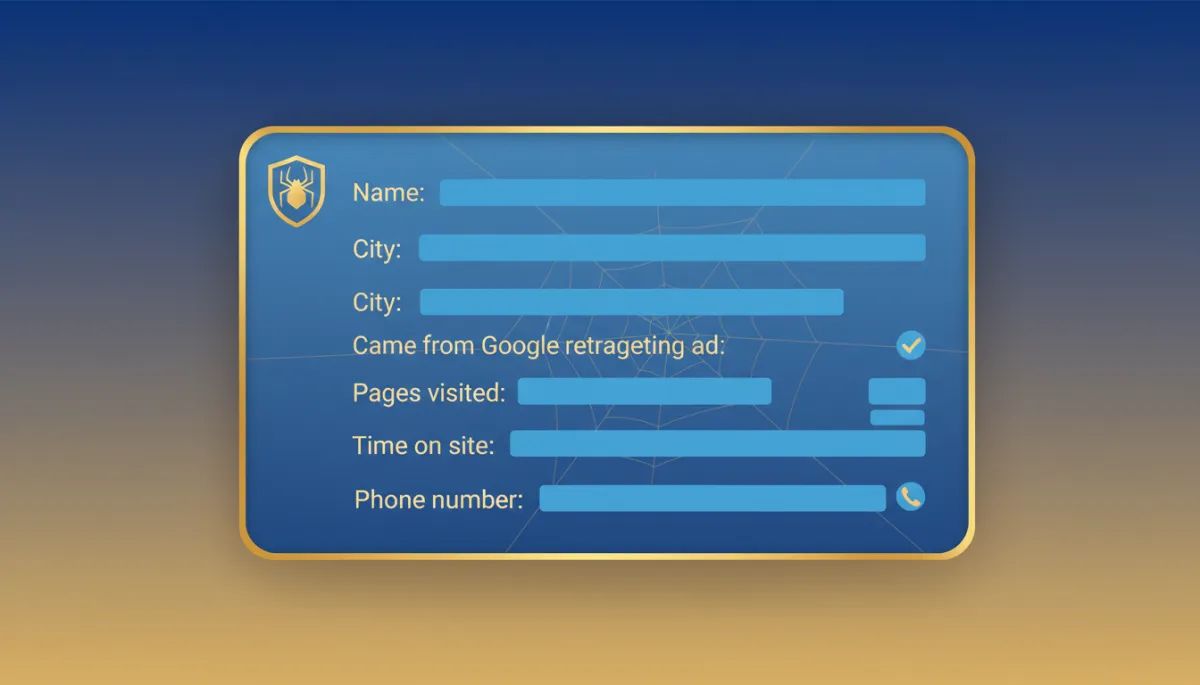
Now your follow-up is not another banner ad. It is a quick call or text: “Hey, I saw you were looking at our pricing page today. Do you have any questions I can answer?”
The timing and context are completely different from a generic ad four weeks later. The visitor is still in buying mode, and the outreach feels like a continuation of the session they just had on your site.
Why Identification Makes Retargeting Optional, Not Mandatory
Retargeting exists to solve one problem: you lost a visitor and want them back. Visitor identification solves that problem differently. You do not “lose” them in the first place because you captured their identity when they visited.
- If they pick up the phone, you are having a real sales conversation instead of hoping they see your ad again.
- If they do not answer, you can still retarget them — but now with identity context.
Instead of blasting anonymous segments, you can run retargeting to specific emails or phone numbers that did not respond. That is a far more precise use of budget than generic “all website visitors in the last 30 days.”
Businesses that start with identification and add retargeting as a secondary channel see better results from both. The retargeting audience is filtered through identification data: you know which visitors were HOT but did not connect, so you know exactly who to keep in front of.
For a deeper look at how this stacks up against Google’s ecosystem, see Google Ads visitor identification. For the Meta side, see Facebook Ads visitor identification.
When Retargeting Still Makes Sense
Visitor identification will not match every visitor. Depending on your traffic, 20–40% might be identifiable, and 60–80% will remain anonymous. Retargeting is still useful for that group.
- Use retargeting for brand awareness and content promotion to the non-identified visitors.
- Show them case studies, testimonial videos, and educational content to move them down the funnel until they return with a stronger identification signal.
Retargeting and identification are not enemies. They are just playing different positions. Identification turns a chunk of your traffic into direct conversations. Retargeting keeps the rest warm until they are ready.
FAQs: Retargeting vs Visitor Identification
What is the difference between retargeting and visitor identification?
Retargeting uses pixel data to show ads to an anonymous audience segment — you never learn who those people are. Visitor identification uses comparable pixel data, matched to an identity graph, to return a specific name, email, and phone number tied to the visit.
Which is more cost-effective: retargeting or visitor identification?
Visitor identification typically delivers a lower true cost-per-acquisition, even if the cost-per-contact is similar or slightly higher. At a 1–2% retargeting conversion rate versus a 10–18% close rate on HOT-scored identified contacts, identification produces more closed customers per dollar spent.
Can I run retargeting and visitor identification at the same time?
Yes, and you should. Identification converts the 20–40% of visitors who match to the identity graph into direct outreach opportunities. Retargeting works the remaining 60–80% who did not match, showing them more content and brand exposure to drive return visits and higher intent.
Why is visitor identification better than retargeting for high-ticket services?
High-ticket services — legal, solar, financial advisory, plastic surgery, and similar — have large enough deal values that speed and directness matter. A $28,000 solar installation or a $50,000 legal case easily justifies a five-minute call to an identified HOT visitor. Letting those people drift through six weeks of banner ads is leaving serious revenue on the table.
Your traffic already has names on it. You just cannot see them yet.
[Start Free 7-Day Hunt] — https://leadspyder.ai/start
No contract. 30-day money-back. Live in under 10 minutes.